Skip to main content
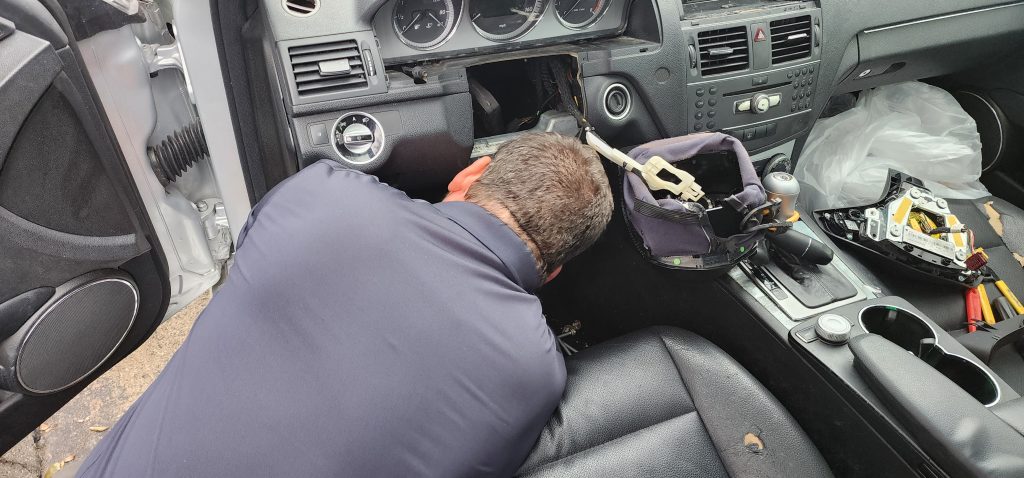
You’re sitting in your car, key in the ignition, and it won’t turn. Or it turns but the engine won’t start. Maybe the key goes in halfway and stops, or it turns with a grinding sensation that makes your stomach drop. Ignition problems are more common than most people think, and they range from minor annoyances to situations that leave you completely stranded.
Before you assume you need a new car or a $1,500 repair from the dealership, here’s what’s actually going on and what it takes to fix it.
How Your Ignition System Works
The ignition cylinder is a mechanical lock built into your steering column. When you insert and turn your key, the cylinder rotates through several positions — accessory, on, and start. Each position activates different electrical circuits in the vehicle.
In modern vehicles, the ignition cylinder also works with the immobilizer system. The antenna ring surrounding the cylinder reads your transponder key’s chip and verifies it before allowing the engine to start.
This means ignition problems can be mechanical (the cylinder itself), electrical (the switch behind the cylinder), or electronic (the immobilizer system). Each has different symptoms and different solutions.
Common Ignition Problems and Their Causes
The Key Won’t Turn
This is the most common ignition complaint. You insert the key and it simply won’t rotate. Common causes:
Steering wheel lock. When you park and remove the key, the steering column locks. If the wheel is turned hard against the lock, it creates binding pressure that prevents the ignition from turning. The fix is simple — wiggle the steering wheel left and right while gently trying to turn the key. The pressure will release and the key will turn normally.
Worn key. Over years of use, the key blade wears down. The peaks and valleys that match the lock tumblers become rounded and shortened. The key still fits the ignition but can no longer push the tumblers into the correct position. Solution: get a new key cut from the vehicle’s key code, not from the worn key.
Debris in the cylinder. Dirt, lint from pockets, and tiny debris accumulate inside the ignition cylinder over time. Florida’s humidity can also cause internal corrosion. A locksmith can clean and lubricate the cylinder, or replace it if the damage is too far gone.
Worn cylinder tumblers. The tumblers (wafers) inside the ignition cylinder wear down over thousands of key insertions. When they wear enough, they don’t align properly with the key. This usually develops gradually — the key becomes harder to turn over weeks or months.
The Key Turns But the Engine Won’t Start
If the key rotates normally through all positions but nothing happens when you hit the start position:
Immobilizer issue. The transponder chip in your key may have failed, or the antenna ring around the ignition cylinder isn’t reading it. You’ll usually see a security light on the dashboard — a key symbol or padlock icon.
Ignition switch failure. The mechanical cylinder might be working fine, but the electrical switch behind it (which sends the start signal) has failed. This is a separate component from the cylinder itself.
Starter relay or starter motor. Not actually an ignition problem, but it presents the same way. A clicking sound when you turn to start usually points to a starter issue rather than the ignition.
The Key Gets Stuck
A key that goes in but won’t come out is usually a sign of a worn cylinder. The tumblers are hanging up and trapping the key blade. Don’t force it — you risk breaking the key off inside the cylinder, which turns a $150 repair into a more involved extraction and replacement job.
Grinding or Rough Turning
If the key turns with a gritty, grinding sensation, the internal tumblers or springs are failing. This is a warning sign — the cylinder is on its way out and will eventually fail completely. Getting it serviced or replaced now prevents a roadside failure later.
Mercedes-Benz EIS Problems: A Category of Their Own
If you drive a Mercedes-Benz, ignition problems are an entirely different animal. Mercedes doesn’t use a traditional ignition cylinder like most vehicles. Instead, they use an Electronic Ignition Switch (EIS) — sometimes called the EZS (Elektronisches Zündschloss) — that’s part electronic module, part mechanical lock, and entirely Mercedes-specific in how it fails.
The EIS is the slot where you insert your Mercedes key. It looks simple enough from the outside, but inside it contains a circuit board with a motorized lock mechanism, an infrared receiver, a transponder antenna, and its own processor that communicates with the vehicle’s electronic control modules. When it works, it’s seamless. When it fails, the car is completely dead.
How the Mercedes EIS Works
When you insert a Mercedes key into the EIS, several things happen simultaneously:
The mechanical portion of the key engages the lock cylinder inside the EIS. The infrared transmitter in the key sends a signal to the EIS receiver. The EIS reads the key’s transponder chip through its built-in antenna. The EIS processor verifies the key’s identity against its internal memory and communicates with the vehicle’s ECU (Engine Control Unit) and ESL (Electronic Steering Lock) to authorize the engine to start.
All of this happens in under a second. But if any part of that chain fails — the EIS board, the IR receiver, the motor, or the communication link to the ECU — you’re stuck.
Common Mercedes EIS Failure Symptoms
Key not recognized. You insert the key and the dashboard displays “Key not recognized” or “Insert key” even though the key is fully seated. This is often the EIS’s internal reader failing rather than the key itself. If you have two keys and neither works, the EIS is almost certainly the problem.
Intermittent starting. The car starts fine some days and refuses to start on others. You might need to insert and remove the key multiple times before it catches. This intermittent behavior is a hallmark of an EIS module that’s beginning to fail — the solder joints on the internal circuit board are cracking from thermal cycling.
Steering lock malfunction. The dashboard shows a steering lock warning and the engine won’t crank. Mercedes uses an electronic steering lock (ESL) that works in conjunction with the EIS. When the EIS can’t communicate properly with the ESL, the car thinks the steering is still locked and blocks the engine start as a security measure.
Complete electrical dead spot. You insert the key and absolutely nothing happens — no dashboard lights, no chimes, nothing. In some cases the EIS fails entirely, which can mimic a dead battery. If your battery tests fine but the car won’t respond to the key at all, the EIS is a strong suspect.
Key turns but won’t return to the off position. The motorized mechanism inside the EIS can seize, trapping the key in the on position. This is a mechanical failure of the EIS motor, not a key problem.
Which Mercedes Models Are Most Affected
EIS problems are most common on Mercedes vehicles from roughly 2000 to 2014, particularly:
W203 C-Class (2001–2007) — One of the most frequently affected models. The EIS module in these vehicles is known for premature failure, especially in hot climates like Florida.
W211 E-Class (2003–2009) — The EIS and ESL combination in this generation is a well-known weak point. Failures often occur between 80,000 and 150,000 miles.
W164 ML-Class (2006–2011) — Similar EIS architecture to the W211, with similar failure patterns.
W221 S-Class (2006–2013) — The EIS in the flagship sedan uses the same basic design and suffers from the same issues.
W204 C-Class (2008–2014) — Improved over the W203 but still susceptible, particularly in vehicles with higher mileage.
Newer Mercedes models (2015+) with the Keyless Go push-button start system have moved away from the traditional EIS design and are less prone to these specific failures, though they have their own electronic quirks.
Why EIS Failures Are Common in Florida
Heat is the number one killer of Mercedes EIS modules. The circuit board inside the EIS sits in the steering column, which absorbs significant heat from the cabin — especially in a car parked in a Florida parking lot where interior temperatures regularly exceed 150°F in summer.
This extreme heat causes the solder joints on the EIS circuit board to expand and contract repeatedly. Over thousands of cycles, the solder cracks and the electrical connections become intermittent. This is why EIS failures often start as occasional no-start events and gradually become more frequent until the module dies completely.
Brevard County’s combination of summer heat and coastal humidity makes it a particularly harsh environment for these modules. We see a higher rate of EIS failures in vehicles driven along the coast — Cocoa Beach, Merritt Island, Satellite Beach — where salt air accelerates corrosion of the module’s internal connections.
EIS Repair Options
There are three approaches to fixing a failed Mercedes EIS, and the right one depends on the specific failure:
EIS repair / remanufacture. A skilled technician can remove the EIS module, disassemble it, and repair the failed solder joints or replace damaged components on the circuit board. This is the most cost-effective option when the failure is electrical (bad solder joints, failed IR receiver) rather than mechanical (seized motor). A repaired EIS retains your original key data, so your existing keys continue to work without reprogramming.
Used EIS replacement. This is not recommended. A used EIS from another vehicle contains that vehicle’s key data, which must be overwritten with yours. This process — called EIS/ECU virgin/renewal — requires specialized equipment and carries risk. If done improperly, you can end up with a vehicle that won’t start at all and needs both the EIS and ECU replaced. Some shops attempt this as a cheap fix, but the failure rate makes it a gamble.
New OEM EIS replacement. A brand-new EIS module from Mercedes is the most reliable fix but also the most expensive. The new module arrives blank and must be programmed with new key data, which means new keys must be cut and programmed as well. Through a dealership, this process can cost $1,500–$3,000+ including parts, programming, and labor.
A qualified automotive locksmith with Mercedes-specific equipment can perform EIS repair or new EIS programming at a fraction of the dealership cost — and at your location rather than requiring a tow.
How to Tell If It’s the EIS or the Key
Before assuming the EIS has failed, rule out the key itself:
Try both keys. If you have two Mercedes keys and both exhibit the same symptoms, the EIS is the likely culprit. If one key works fine and the other doesn’t, the problem is probably the key.
Check the key battery. Mercedes key fobs use a small battery for the remote lock/unlock function. A dead battery won’t affect the transponder (which is powered by the EIS antenna), but it will disable the infrared communication that some EIS modules rely on.
Look for dashboard messages. “Key not recognized” with a known-good key points to the EIS. A security light (steering wheel icon) combined with no-crank often indicates an ESL/EIS communication failure.
Note the pattern. If the problem is worse when the car has been sitting in the sun and better on cool mornings, that’s a classic thermal solder failure inside the EIS.
If you’ve lost your Mercedes key entirely, the process is more involved — we covered that in detail in our guide on securing a lost Mercedes key.
Ignition Repair vs. Replacement
A skilled locksmith can often repair an ignition cylinder rather than replace it entirely. Repair involves disassembling the cylinder, replacing worn tumblers or springs, and reassembling it. This preserves your existing key — no need for new keys.
Replacement is necessary when the cylinder is too damaged for repair — severe wear, broken housing, or corrosion damage. A replacement cylinder can be keyed to match your existing key in most cases, so you don’t end up with separate keys for the ignition and doors.
Cost comparison: Ignition repair typically runs $100–$200. Full cylinder replacement with rekeying is $150–$350 depending on the vehicle. Compare that to dealership quotes of $400–$800+ for the same work. For Mercedes EIS repairs, expect $300–$600 through a qualified locksmith versus $1,500–$3,000+ at the dealership.
Why Brevard County Cars Have More Ignition Issues
Florida’s climate is harder on ignition systems than most people realize. The combination of high humidity, salt air near the coast, and temperature fluctuations accelerates corrosion inside the cylinder.
Vehicles regularly driven on barrier island communities — Cocoa Beach, Satellite Beach, Indian Harbour Beach, Melbourne Beach — see more salt air exposure. The salt causes micro-corrosion on the brass tumblers and the key blade, gradually degrading the fit.
Heat is another factor. Steering columns absorb significant heat from sun-baked dashboards, and repeated thermal expansion and contraction loosens the fit between tumblers and the cylinder housing.
Regular lubrication with a graphite-based lubricant (never WD-40, which attracts dust) can extend the life of your ignition cylinder significantly.
Ignition Repair in Brevard County
Key-En-Lock provides mobile ignition repair and replacement services throughout Brevard County — including Mercedes EIS diagnostics and repair. We diagnose the issue at your location — whether it’s a worn key, failing tumblers, a damaged cylinder, an immobilizer problem, or a failing Mercedes EIS module — and complete the repair on-site in most cases.
No towing, no dealership wait times, no inflated repair bills. If you’re having ignition trouble, call (321) 224-5625 before the problem gets worse.
Serving Brevard County
Need a local locksmith? We serve nearby areas including:
- Locksmith South Patrick Shores locksmith
- locksmith in Locksmith Patrick Space Force Base
- Locksmith Merritt Island locksmith
- Locksmith West Melbourne locksmith
- locksmith in Locksmith Melbourne Beach
- emergency locksmith Locksmith Palm Bay
See all locations: Service Areas or call (321) 224-5625.