Skip to main content

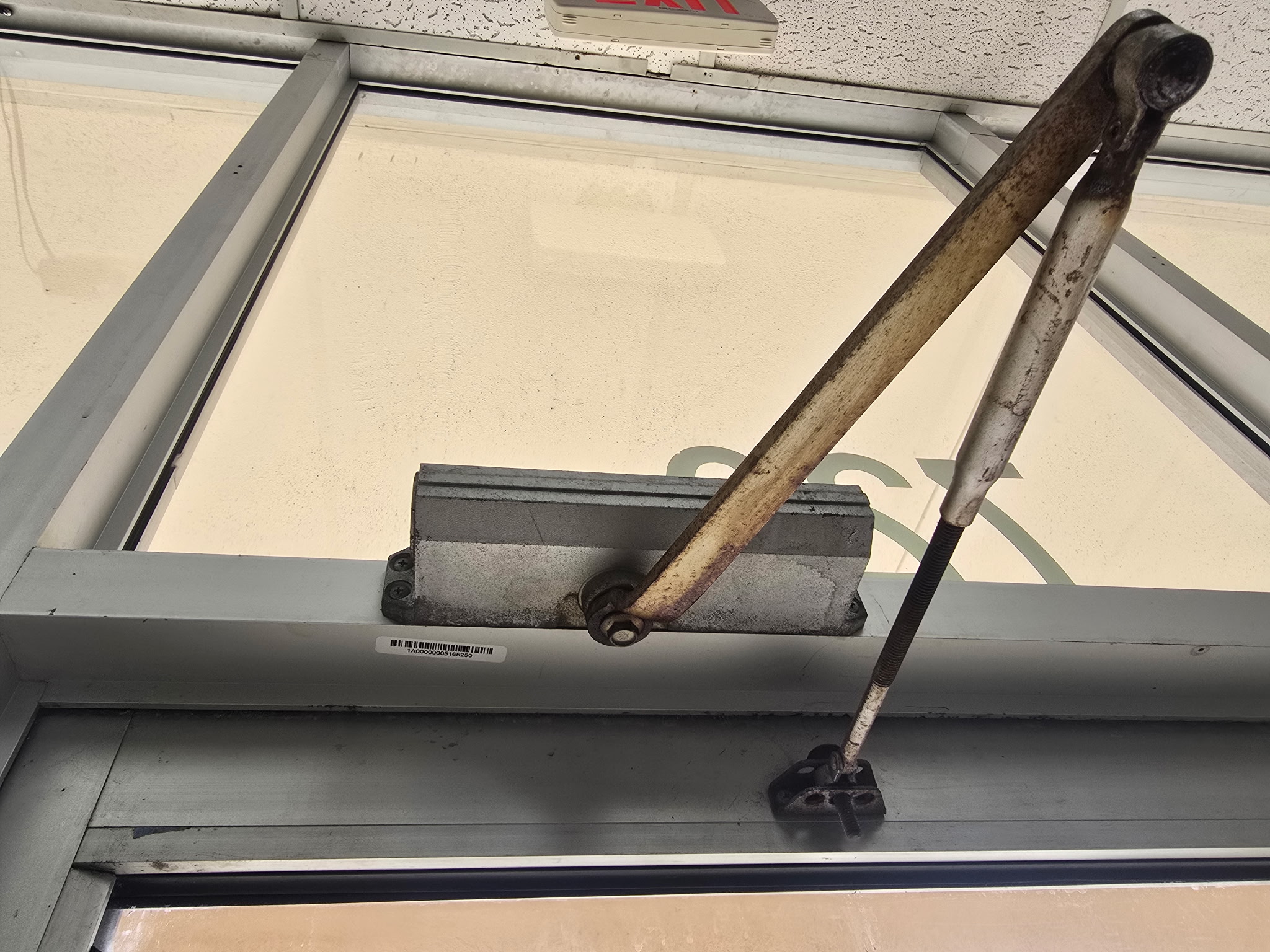
That door closer on your commercial or residential door might not seem like a priority. It still sort of works. The door closes — eventually. But a failing door closer is one of those things that goes from “minor annoyance” to “serious injury” faster than most people expect. We’ve seen it happen. Broken hands, crushed fingers, doors that fly open and take someone off their feet. This is not a component you want to defer on.
What a Door Closer Actually Does
A door closer is a hydraulic mechanical device that controls the speed and force at which a door swings closed. Inside the housing is a spring mechanism and a hydraulic cylinder filled with oil. The spring provides the closing force; the hydraulic fluid controls the speed so the door doesn’t slam. Adjustment valves let you tune the sweep speed, the latch speed, and the backcheck — the resistance you feel when the door is pushed open too hard.
On commercial properties, door closers also serve a critical fire safety function. Fire-rated doors are required by code to have working closers that fully latch the door — a failed closer on a fire door can mean the difference between a contained incident and a catastrophic one.
Signs Your Door Closer Needs to Be Replaced
1. Hydraulic Fluid Leaking
This is the most obvious sign — and once it starts, the closer is done. The hydraulic fluid inside the cylinder is what controls the door’s closing speed. When the seals fail (and they will eventually, especially in Florida’s heat and humidity), oil begins to weep out of the housing. You’ll see a dark oily stain on the closer body, on the door frame, or dripping down the door.
Once the fluid is gone, there is no speed control. The spring will slam the door with full unregulated force — and that’s when people get hurt. There is no repairing a leaking door closer. The seals are not serviceable from the outside and replacement parts are not available for most consumer and commercial grade units. A leaking closer must be replaced.
2. Door Slams Shut
If your door is slamming, the hydraulic control is gone — either from fluid loss or from the internal valve mechanism failing. A slamming door is not just loud and annoying. It is genuinely dangerous. A solid commercial door weighing 80–150 pounds closing at full spring speed will injure anyone in its path. Children, elderly people, and anyone who isn’t paying close attention to door timing are all at risk.
We have responded to commercial properties where employees developed hand injuries from repeatedly catching a slamming door to prevent it from hitting customers. The cumulative strain from that alone causes real damage. And that’s before accounting for the direct impact injuries when someone doesn’t get their hand or foot clear in time.
3. Door Won’t Fully Close or Latch
A closer that has lost spring tension will let the door drift to a stop before it fully latches. This is a security problem — an unlatched door is easy to push open from outside without a key. It’s also a fire code violation on rated doors. If your door is consistently stopping short of the latch, the closer’s spring has weakened and replacement is needed.
4. Closer Arm Is Bent, Cracked, or Binding
The arm that connects the closer body to the door is a mechanical component under constant stress. Over time — especially if the door has been forced open beyond its stop, hit by a cart or vehicle, or had the backcheck fail — the arm can bend, crack at a joint, or develop binding that causes the door to hesitate and jerk during operation. A bent arm puts uneven stress on the closer body and the door frame, and will accelerate failure of the hydraulic seals.
5. Visible Corrosion or Physical Damage
In Brevard County’s coastal environment, salt air accelerates corrosion on exterior door hardware significantly. A closer that looks heavily rusted or corroded externally has almost certainly suffered internal corrosion as well. Corroded internal components cause erratic operation and accelerated seal failure. If your exterior closer looks rough, don’t wait for it to fail completely.
The Real Danger: Injuries from Failed Door Closers
This is the part most people don’t think about until it happens to them or someone they know.
A door with a failed closer carrying a 100-pound slab of steel, glass, or solid wood — closing at full spring speed with no hydraulic damping — generates tremendous force. Injuries from failed door closers include:
- Broken fingers and hands — The most common injury. Someone reaches back to grab the door as it swings and gets their fingers caught between the door edge and the frame. At full closing speed the force is enough to fracture bones instantly.
- Amputations — In severe cases involving heavy fire doors or industrial doors, finger amputations have occurred. This is documented in workplace injury records and OSHA citations. It sounds extreme until it happens.
- Head and facial injuries — A door that swings back hard can strike someone following close behind. This is especially dangerous at the face level of children.
- Slip and fall injuries — A door that fails to stay open can swing back and knock someone off balance, particularly the elderly or anyone carrying items through the doorway.
- Wrist and shoulder injuries — People instinctively try to catch a slamming door. The force transferred through the arm during that catch can cause sprains, strains, and in severe cases fractures.
OSHA takes door closer failures seriously in commercial settings. Under the General Duty Clause, employers are required to maintain workplace equipment — including doors — in a safe condition. A documented leaking or slamming door closer that leads to an employee injury is a liability exposure most business owners would not want to face.
How Long Should a Door Closer Last?
A quality commercial door closer installed correctly on a door that isn’t abused should last 10–15 years. Budget closers on high-traffic doors may fail in 3–5 years. Several factors shorten lifespan significantly in Brevard County:
- Salt air and humidity — Coastal environments are hard on seals and external hardware
- UV exposure — Florida sun degrades rubber seals faster than in northern climates
- High traffic — A closer on a door that opens 200 times per day wears much faster than one on a door that opens 20 times per day
- Improper adjustment — A closer adjusted too tight puts excessive stress on the hydraulic cylinder and arm
- Door abuse — Doors repeatedly forced open past their stop, propped open with the closer under tension, or hit by vehicles or equipment
Can You Adjust a Door Closer Instead of Replacing It?
Yes — if the closer is still functioning mechanically and hydraulically, adjusting the speed valves can fix a door that’s closing too fast or too slow. Most door closers have two to three adjustment screws accessible on the end cap or body of the unit that control sweep speed, latch speed, and backcheck. If your door is closing too fast but not leaking and not slamming, an adjustment may be all that’s needed.
However, adjustment cannot fix a leaking closer. It cannot fix a closer that has lost its hydraulic fluid. It cannot fix a bent or cracked arm. And it cannot fix a closer whose spring has lost tension. Those all require replacement.
Door Closer Replacement in Brevard County
Key-En-Lock installs and replaces door closers throughout Brevard County — residential, commercial, and industrial. We stock a range of commercial-grade closers suitable for most standard door applications, and we can source heavy-duty closers for high-traffic or specialized applications.
We carry closers rated for standard, heavy-duty, and institutional service, including fire-rated door compliant models. If you’re not sure what you need, we assess the door, the traffic level, and the environment and recommend the right unit — not the most expensive one.
Don’t wait for someone to get hurt. If your closer is leaking, slamming, or failing to latch, call us. It’s a straightforward replacement that takes under an hour in most cases and eliminates a real safety hazard.
For related commercial door hardware services, see our Commercial Locksmith page. For residential door hardware including deadbolt installation and lock replacement, visit our Residential Locksmith page. If you’re concerned about overall door security and access control for your business, our Access Control page covers the full range of options we offer in Brevard County.
Call (321) 224-5625 or contact us online to schedule door closer replacement anywhere in Brevard County — Melbourne, Palm Bay, Viera, Cocoa, Titusville, Rockledge, Merritt Island, and all surrounding areas.
About Key-En-Lock
Key-En-Lock is a licensed, family-owned mobile locksmith serving all of Brevard County since 1999. Founded by Patrick Keeney, we specialize in residential and commercial locksmith services, automotive key programming, safe opening and repair, door hardware installation, and PDK.io cloud access control. We come to you — fully equipped, upfront pricing, no hidden fees.
Licensed through the Florida Department of Business and Professional Regulation. Serving Melbourne, Palm Bay, Titusville, Cocoa, Viera, Rockledge, Merritt Island, Satellite Beach, and all of Brevard County.
Serving Brevard County
Need a local locksmith? We serve nearby areas including:
- locksmith in Locksmith Merritt Island
- locksmith in Locksmith South Patrick Shores
- emergency locksmith Locksmith Titusville
- locksmith in Locksmith Satellite Beach
- emergency locksmith Locksmith Indialantic
- emergency locksmith Locksmith Cape Canaveral
See all locations: Service Areas or call (321) 224-5625.