Skip to main content

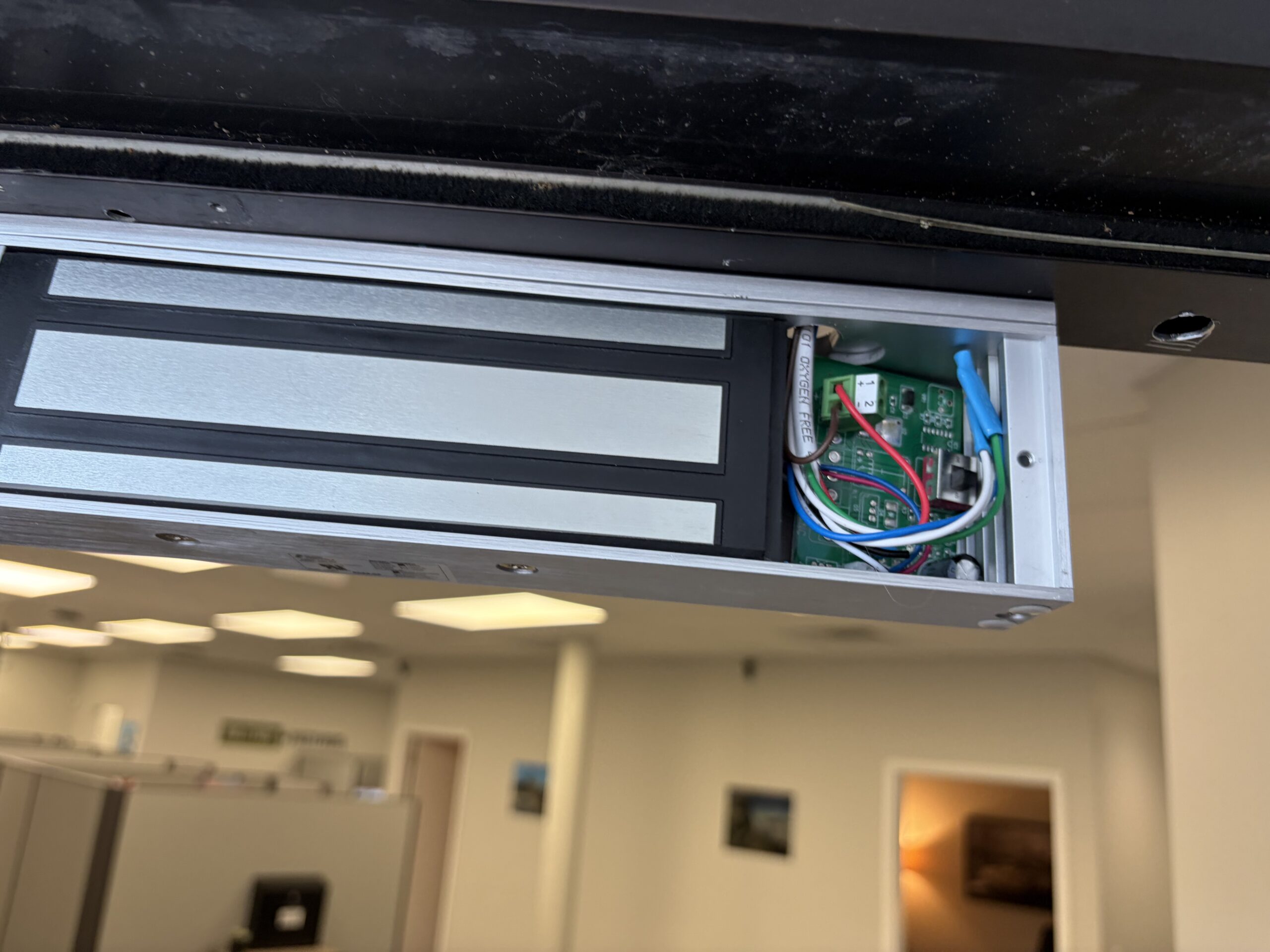
When a business owner decides they want electronic access control on a door — keypad entry, key fob, mobile credential, or remote release — one of the first decisions that needs to be made is what type of electric locking hardware to use. The two most common options are magnetic locks (mag locks) and electronic strikes. They both control access electronically, but they work in fundamentally different ways, have different installation requirements, different code implications, and are suited to different door applications.
Understanding the difference before you buy anything saves you from installing the wrong hardware and having to redo it. Here’s a complete breakdown.
How a Mag Lock Works
A magnetic lock — mag lock — is an electromagnetic device that mounts on the door frame header. It consists of two components: an electromagnet that mounts to the frame, and a steel armature plate that mounts to the door. When power is applied, the electromagnet energizes and creates a powerful holding force between the magnet and the armature plate, holding the door closed. When power is cut — by a keypad code, key fob, push button, or access control system signal — the magnetic field collapses and the door is free to open.
This is called fail-safe operation. When power is lost — whether from a normal access event, a power outage, or a fire alarm signal — the mag lock releases and the door opens freely. This is a critical safety characteristic and a major factor in where mag locks can and cannot be used.
Mag Lock Holding Force
Mag locks are available in a range of holding forces, most commonly:
- 600 lb holding force — Standard single door mag lock, suitable for most interior and light exterior commercial applications
- 1200 lb holding force — Heavy duty, used on high-security doors, double doors, or applications where additional holding strength is required
- Dual mag locks — Two 600 lb units on a double door, providing 1200 lb total holding force with independent control if needed
600 lbs of holding force is substantial. A properly installed mag lock on a standard commercial door is extremely secure when energized. The limiting factor is never the holding force — it’s the mounting hardware and the door frame. A mag lock is only as strong as what it’s anchored to.
When to Use a Mag Lock
Mag locks are the right choice in specific situations — and the wrong choice in others. Here’s where they belong:
Glass Doors and Frameless Glass Applications
This is the most common and best application for mag locks. All-glass doors, frameless glass entries, and glass doors with narrow aluminum frames typically cannot accept an electronic strike because there is no door frame cavity to recess a strike into and no latch or lock mechanism built into the door. A mag lock mounts to the frame header above the door and the armature plate to the top of the glass door panel — no frame modification required beyond the mounting hardware. For glass door applications, a mag lock is almost always the correct solution.
Doors Without a Traditional Latch Mechanism
An electronic strike requires a latch or bolt to strike against — that’s what it’s controlling. If the door has no latch, a strike has nothing to work with. Mag locks don’t care about latches. They hold the door through magnetism against the armature plate regardless of the door hardware configuration, making them the solution for doors that don’t have or can’t practically have a latch.
Applications Requiring Fail-Safe Operation
Anywhere that doors must unlock automatically during a fire alarm, power failure, or emergency evacuation, a mag lock’s fail-safe characteristic is a code requirement. When the fire alarm pulls, the mag lock drops and the door opens. This is built into the design and is why mag locks are commonly specified on fire egress paths, stairwell doors, and anywhere building codes require automatic unlocking on alarm.
High-Traffic Interior Access Control Points
Mag locks work well on interior doors where the primary goal is controlling who can enter rather than providing a high-security lock against forced entry. Server rooms, office suites, storage areas, and interior access control points are all appropriate mag lock applications when paired with a reliable access control system.
When NOT to Use a Mag Lock
Mag locks have real limitations that make them the wrong choice in certain situations:
Exterior Perimeter Doors as Primary Security
Because mag locks are fail-safe — they release when power is lost — they should not be used as the sole security device on exterior perimeter doors unless backed up by a mechanical lock or a secondary locking device. A power outage or a cut wire releases the door. For exterior doors where security must be maintained through a power failure, a fail-secure electronic strike or electrified lock is the better choice.
Doors That Must Resist Forced Entry
While 600 lbs of holding force sounds formidable, a mag lock’s strength is entirely dependent on the quality of the armature mounting and the door construction. On a lightweight door or a frame with flex, the effective holding force is reduced. For high-security applications requiring resistance to forced entry, a properly installed mechanical lock or fail-secure electric strike in a reinforced frame provides more reliable physical security.
Doors Requiring ADA-Compliant Hardware
ADA requirements for accessible doors specify that door hardware must be operable with a closed fist and without tight grasping or twisting. A mag lock by itself doesn’t provide the required egress hardware on the inside — a request-to-exit (REX) button or motion sensor must be installed to release the lock from the inside, and the egress path must comply with code. This is manageable but requires proper planning.
How an Electronic Strike Works
An electronic strike replaces the standard fixed strike plate in the door frame. Instead of a passive metal plate that the latch bolt rests against, an electronic strike has a moving keeper — a hinged or pivoting component that holds the latch bolt when in the locked position. When the strike receives a signal from the access control system, the keeper pivots or retracts, releasing the latch bolt and allowing the door to open.
Electronic strikes can be configured as either fail-safe (releases when power is lost) or fail-secure (remains locked when power is lost), depending on the application requirement. This flexibility is one of their major advantages over mag locks.
Electronic Strikes Work on Virtually Every Door Application
This is the key point that most people don’t realize: electronic strikes can be used on almost any door application. Whether the door has a cylindrical latch, a mortise lock, a rim exit device, a vertical rod panic bar, or a surface-mounted bolt — there is an electronic strike or electrified lock solution designed to work with that hardware. The range of available electronic strike configurations is extensive:
- Standard cylindrical latch strikes — Replace the existing strike plate on any standard commercial door with a cylindrical lockset
- Mortise lock strikes — Work with mortise locksets common on older commercial and institutional doors
- Rim exit device strikes — Electrify the existing crash bar or rim device on an exit door without replacing the panic hardware itself
- Vertical rod panic device strikes — Electrify top and bottom rod panic hardware
- Narrow stile door strikes — Designed for aluminum stile doors where standard strikes won’t fit
- Double door applications — Center mullion strikes and surface vertical rod strikes for pairs of doors
If the door has a latch or bolt of any kind, there is almost certainly an electronic strike solution that works with it. This makes electronic strikes the more versatile option across the full range of commercial door types.
Mag Lock vs Electronic Strike: Side by Side
| Mag Lock | Electronic Strike | |
|---|---|---|
| Power mode | Fail-safe only | Fail-safe or fail-secure |
| Works on glass doors | ✅ Yes | ❌ Usually no |
| Works on doors without latches | ✅ Yes | ❌ No |
| Works with panic hardware | ⚠️ Requires coordination | ✅ Yes |
| Releases on fire alarm | ✅ Automatically | Depends on configuration |
| Maintains security during power outage | ❌ No (fail-safe) | ✅ Yes (fail-secure option) |
| Installation complexity | Moderate — frame header mount | Moderate — frame prep required |
| Aesthetics | Visible on frame header | Concealed in frame |
What About the Access Control System?
Both mag locks and electronic strikes are just the locking hardware — they need a signal from an access control system to operate. That system can be as simple as a standalone keypad with a single door controller, or as comprehensive as a cloud-based platform managing dozens of doors across multiple facilities. Key-En-Lock installs and programs PDK.io cloud access control — a commercial-grade platform that supports keypads, key fobs, mobile credentials, and remote management from anywhere. Whether you need one door or twenty, the PDK.io system scales to fit.
The locking hardware and the access control system have to be specified together. A mag lock wired to the wrong controller, or an electronic strike paired with an incompatible access system, will either not function correctly or create code compliance problems. Getting both sides right from the start is what we do.
Key-En-Lock Installs Both in Brevard County
Whether your application calls for a mag lock, an electronic strike, or a combination of both across multiple doors, Key-En-Lock handles the full installation — hardware selection, wiring, access control programming, and integration with your building’s fire alarm system where required. We serve commercial, industrial, and multi-tenant residential properties throughout Brevard County.
For more on our access control services visit our Access Control page. For commercial door hardware including lock installation, panic hardware, and door closers see our Commercial Locksmith page. For information on PDK.io cloud access control specifically see our PDK.io Access Control page.
Call (321) 224-5625 or contact us online to discuss access control options for your property anywhere in Brevard County — Melbourne, Palm Bay, Viera, Cocoa, Titusville, Rockledge, Merritt Island, Satellite Beach, and all surrounding areas.
About Key-En-Lock
Key-En-Lock is a licensed, family-owned mobile locksmith serving all of Brevard County since 1999. Founded by Patrick Keeney, we specialize in residential and commercial locksmith services, automotive key programming, safe opening and repair, and PDK.io cloud access control. We come to you — fully equipped, upfront pricing, no hidden fees.
Licensed through the Florida Department of Business and Professional Regulation. Serving Melbourne, Palm Bay, Titusville, Cocoa, Viera, Rockledge, Merritt Island, Satellite Beach, and all of Brevard County.
Serving Brevard County
Need a local locksmith? We serve nearby areas including:
- Locksmith Patrick Space Force Base FL locksmith
- Locksmith Melbourne Village locksmith
- locksmith in Locksmith West Melbourne
- Locksmith Cocoa Beach FL locksmith
- Locksmith Palm Bay locksmith
- Locksmith Melbourne Beach FL locksmith
See all locations: Service Areas or call (321) 224-5625.