Skip to main content
You’ve probably seen it stamped right on the key: “Do Not Duplicate.” Sounds official. Sounds like it means something. It doesn’t.
Any hardware store, any key kiosk at Walmart or Home Depot, any locksmith who doesn’t ask questions — they’ll copy that key without blinking. The stamp is a suggestion, not a law. There’s no regulation that prevents someone from walking into a store and saying “I need a copy of this” regardless of what’s printed on it.
So if you’re relying on a “Do Not Duplicate” stamp to control who has access to your building, your office, or your rental property — you don’t actually have key control at all.
What Key Control Actually Means
Key control means that no one can get a copy of your key without your explicit authorization. Not your employees. Not your tenants. Not anyone who happens to have the key in their hand for five minutes. True key control requires two things: a key that physically cannot be duplicated on standard equipment, and a system that tracks who is authorized to request copies.
That’s where restricted and high-security keys come in.
Standard Keys: Open Season
A standard pin tumbler key — the kind on most homes and many businesses — is one of the simplest things in the world to copy. The key blanks are sold everywhere. The cutting machines are in every hardware store. Some big box stores have automated kiosks where you don’t even interact with a person. Put the key in, pay four dollars, walk out with a copy.
This means anyone who borrows your key for even a few minutes can have a duplicate made. A contractor working on your property. An employee who’s about to quit. A tenant who hands their key to a friend. You’d never know.
And it’s not just duplication. Standard keys can also be bumped or picked with relatively basic tools and a little bit of knowledge. The pin tumbler design hasn’t fundamentally changed in over a century, and the techniques to defeat it are well documented.
Restricted Keys: Authorization Required
Restricted key systems use patented keyways — the shape of the key blade and the profile of the cuts are unique to that manufacturer and that specific system. The key blanks are not available at hardware stores. They’re not available online. They’re only sold to authorized dealers, and those dealers are contractually required to verify authorization before cutting a copy.
Here’s how it works in practice: When we install a restricted key system for you, you receive an authorization card. If you need additional keys, you bring that card to us (or call us with the authorization number), and we cut the keys for you. Nobody else can get a copy — not the hardware store, not a random locksmith, not the key kiosk at the supermarket. Without the blank, they literally cannot make the key.
The most common restricted systems we install are:
Medeco — One of the most recognized names in high security. Medeco keys use a combination of angled cuts and rotating pins that make them virtually impossible to pick or bump. The key blanks are patented and tightly controlled. Medeco has been protecting government buildings, hospitals, and banks for decades, but they’re just as practical for a small business or a landlord managing rental properties.
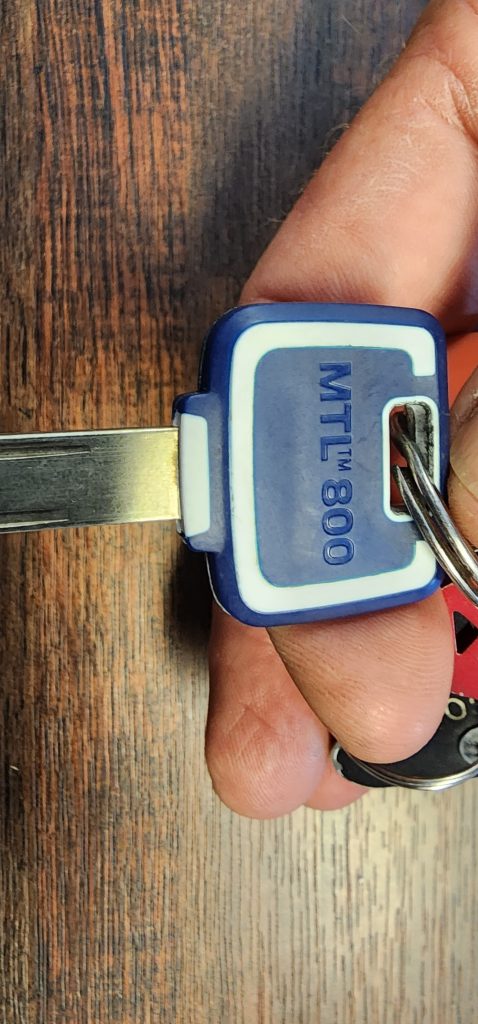
Mul-T-Lock — Uses a unique pin-in-pin design where each key pin contains a second, smaller pin inside it. This makes the lock extremely resistant to picking and bumping. Mul-T-Lock also uses patented key blanks with restricted distribution. Their Interactive+ line adds a movable element in the key that communicates with the lock, adding yet another layer of duplication protection.
Schlage Primus — Adds a secondary locking system (a sidebar) to Schlage’s already solid commercial locks. The Primus key has a unique fingerpin milling on the side of the blade that operates this sidebar. Without the correct sidebar cuts, the lock won’t open even if the standard pin cuts are correct. Primus blanks are factory-restricted.
High-Security vs. Restricted: What’s the Difference?
These terms are often used interchangeably, but they’re not exactly the same thing.
Restricted refers specifically to key control — the blanks are patented and can only be obtained through authorized channels. This prevents unauthorized duplication.
High-security refers to the lock’s resistance to physical attack — picking, bumping, drilling, and forced entry. High-security locks are built with tighter tolerances, hardened materials, and anti-manipulation features.
The best systems, like Medeco and Mul-T-Lock, are both restricted and high-security. You get key control so no one can copy your key without permission, and you get a lock that resists physical attack. It’s the full package.
Who Needs Restricted Keys?
If you can answer yes to any of these, you should seriously consider upgrading:
Property managers and landlords — Every time a tenant moves out, do you really know how many copies of that key exist? Their friends, their dog walker, their ex? A restricted system means when you rekey between tenants, the old keys are truly dead and new ones can’t be copied without your say-so.
Business owners — Employees come and go. Cleaning crews have access after hours. Delivery drivers have keys to receiving doors. With standard keys, any of them could have made copies you don’t know about. Restricted keys put you back in control.
Medical offices and pharmacies — You have a legal obligation to control access to certain areas. Standard keys don’t meet that standard. Restricted key systems with audit trails do.
Schools and government buildings — Master key systems in these environments are often massive and complex. If even one unauthorized key gets into the wrong hands, the entire system can be compromised. Restricted blanks prevent this.
Homeowners who want the best — If you keep valuables at home, or if you simply want the peace of mind that comes with knowing your keys can’t be copied behind your back, a restricted system on your exterior doors is a worthwhile investment.
What About Those Key Kiosks?
Automated key-cutting kiosks like KeyMe and MinuteKey have made the problem worse. These machines can copy most standard keys in under a minute, and some can even scan a key from a photo. They don’t ask questions. They don’t check authorization cards. They just cut.
Restricted keys are immune to these machines because the blanks don’t exist in their inventory. The patented keyway profiles are not available to third-party manufacturers. You can take a Medeco key to a KeyMe kiosk all day long — it will tell you it can’t make that key. That’s the point.
The Cost Difference
Yes, restricted and high-security keys cost more than standard keys. A standard key copy at a hardware store runs two to five dollars. A restricted key from an authorized dealer typically runs fifteen to thirty dollars depending on the system.
But consider what you’re paying for. You’re paying for the guarantee that no unauthorized copies exist. You’re paying for a lock that can’t be picked or bumped by someone with a ten-dollar tool kit from Amazon. You’re paying for real security instead of the illusion of it.
For a business, the cost of a restricted key system is nothing compared to the cost of a break-in, a theft, a liability claim, or the expense of rekeying an entire building because one employee made copies before they were fired.
How to Upgrade
Switching to restricted keys doesn’t always mean replacing all your locks. In some cases, we can rekey your existing hardware to accept restricted key blanks, depending on the lock brand and model. In other cases, a lock replacement makes more sense, especially if your current locks are older or lower-grade.
We’ll assess what you have, recommend the right system for your situation, and give you a straight price before any work starts. We’re authorized dealers for Medeco, Mul-T-Lock, and Schlage Primus, which means we can supply, install, and service these systems directly.
If you’re tracking keys in our Key Tracker tool and noticing that you’ve given out more copies than you’re comfortable with — that’s a sign. It might be time to switch to a system where unauthorized duplication simply isn’t possible.
Call (321) 224-5625 to talk about restricted key options for your home or business. We serve all of Brevard County and we’ll come to you for a free assessment.
Serving Brevard County
Need a local locksmith? We serve nearby areas including:
- Locksmith Patrick Space Force Base FL locksmith
- Locksmith Melbourne Village locksmith
- Locksmith Palm Bay locksmith
- locksmith in Locksmith Merritt Island
- Locksmith Melbourne Beach FL locksmith
- Locksmith Rockledge FL locksmith
See all locations: Service Areas or call (321) 224-5625.